Posts

Showing posts with the label Technology

Network Types - Low Temperature District Heating

Image
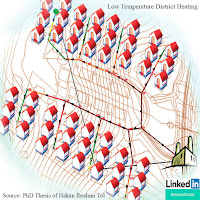
A short introduction about distribution network types with photos from nature. Please give a focus how the veins of these leafs in the photo are structured. Some branched, some having a loop formation and some a mixture of both! A question rises that highlights the necessity of distribution systems in our lives, especially district heating/cooling networks: why such natural elements have a structure of distribution instead of individual production? Please think about various forms of distribution in the nature: you can find lots of examples i.e. the blood vessels, neural system, etc.! The network layout (network topology) is briefly described after this inspiring-from-nature photo below.  Network Types with Different Layouts as Observed in the Leafs: Inspiration to the Centralized Energy Networks Obvious that nature at most uses centralized distribution to satisfy the local needs. So do the district heating systems! Although in my publications the network layout was took...

Substation Types - Low Temperature District Heating

Image
A brief introduction can be rewarding about the substation types while talking about Low Temperature District Heating Systems.  Source: Tol, Hakan İbrahim, 2012, District Heating in Areas with Low Energy Houses (PhD Thesis) First thing that comes to mind, in Low Temperature District Heating Systems, is if the low temperature supply at a temperature of 55°C can cause legionella growth or not while producing the domestic hot water. One of the solutions to overcome the legionella growth can be by equipping storage tank before the heat exchanger in the substations with indirect connection. Hence the storage tank (also termed as Heat Accumulator and Buffer Tank) will store the medium circulated in the distribution network not the domestic hot water that is used directly from the tap. According to the German Standard, if the volume storing the domestic hot water medium is less than 3 liter there is no minimal limit for the supply temperature [1]. Hence, keeping the volume of th...

Glossary - Low Temperature District Heating

Image
Low Temperature District Heating Systems, the 4th generation (4G) district heating technology, are superior with their low degrees of temperature that is commonly with 55°C of supply and 25°C return. In this blog post, the terminology commonly used in the field of low temperature district heating systems is published to keep the consistency/standardization of the terms. Some being newly famous with the low temperature upgrade, though most are already common in the field of District Heating technology. Links for the original document which this blog post based on are provided at the bottom of the page. Description of the Terms  Low Temperature: Excessively low temperature supply of about 50°C to the heated space Low Energy: Used for district heating systems operating at low temperatures. Low grade: Surplus heat at low temperatures which it is hard to exploit. Heat carrier medium: A medium consisting of a fluid used to transport heat in such a way that a change in...

Mathematics and Nature

Image
The creation of Hz. Allahü Teala: the nature involves colorful rainbows, perfectly constructed spider webs, faultless form of the snail shell etc., Each of them in its deep basis reveals mathematics in several forms such as numbers, formulations etc.  An amazing animation video "Nature by Numbers", prepared by Cristóbal Vila, shows us some examples pointing the cross-bond between mathematics and nature. Please watch this artful animation movie with the melody of "Often a Bird" by Wim Mertens (from the album Jardin Clos, 1996). More Examples: Fractals - Patterns of Mathematics World Mysteries Math is Fun Golden Ratio

Some Good Websites About Engineering

Image
Some useful web sites about engineering: http://www.engineeringtoolbox.com/ Description:  Resources, Tools and Basic Information for Engineering and Design of Technical Applications! http://www.calculatoredge.com/ Descrip tion:   An online FREE Engineering Calculators for Engineers and Students worldwide, the website features more than few hundred calculators for solving complex equations and formulas in field of Electrical, Mechanical, Chemical, Electronics, Civil, Metallurgy, Oil & Gas, Optica l, Plastics, Ceramics, Physics, Maths and many more to come.... http://www.eng-tips.com/ Description: Forum for engineers.

Web Links of Vacancies in Some Universities

Direct web links to the job opportunities of some universities are given below: MIT, US The University of Sydney, Australia DTU, Copenhagen, Denmark NTNU, Trondheim, Norway Lund University, Lund, Sweden